

· By Bedly
How to Actually Build a Sleep Schedule in College (When Your Life Is Chaos)
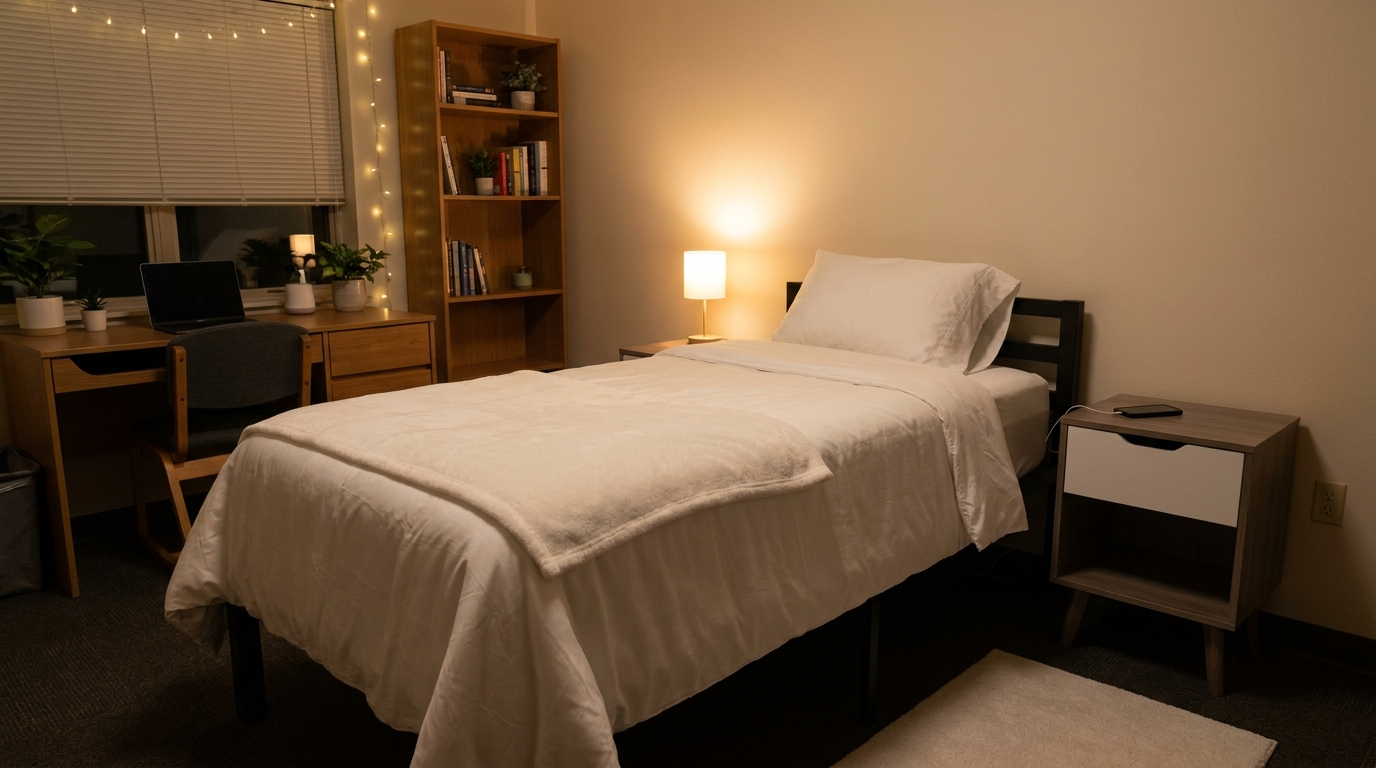
Nobody Warned You About Dorm Sleep
High school had a bell that told you when to be somewhere. College has... nothing. Suddenly you're in charge of your own schedule, your roommate is watching TikTok at 2 AM, and your "bedtime" is somewhere between midnight and "when did the sun come up?"
Building a sleep schedule in college isn't about being boring. It's about actually having energy to do the things you want to do. Here's how to make one that works in a dorm—without turning into a 9 PM bedtime person who nobody invites to things.
Why Dorm Life Makes Sleep Schedules Hard
Before fixing anything, it helps to understand what's working against you:
- No fixed schedule. Classes might start at 8 AM one day and noon the next. That inconsistency messes with your body's internal clock.
- Shared space. Your roommate's schedule isn't yours. Their alarm, their keyboard, their midnight snack—all of it affects your sleep window.
- Social pressure. Hanging out until 1 AM is basically the default college social setting. Saying "I'm going to bed" at 11 PM can feel weird, at least at first.
- Uncomfortable beds. If your dorm mattress is making you toss and turn, no sleep schedule is going to save you.
The Basics of a College Sleep Schedule
Pick a Wake Time You Can Actually Keep
Most sleep advice says "go to bed at the same time every night." That's harder to control in college than waking up at the same time. Find a wake time you can stick to at least five days a week and build backward from there.
Most adults need 7–9 hours. If you want to wake up at 8 AM, you should be asleep—not just in bed—by midnight or 1 AM. Plan accordingly.
Anchor Your Day with Two Fixed Points
You don't need a rigid minute-by-minute routine. Just anchor your day with two things you do at the same time every day: when you get up and when you wind down. Everything else can flex around those.
Create a Wind-Down Window
Your brain doesn't switch off instantly. Give yourself 20–30 minutes before sleep that aren't doom-scrolling, group chats blowing up, or stressful homework at midnight. Read something, listen to music, take a shower. Just something low-stimulation.
This isn't a wellness lecture. It just works.
Making Your Dorm Bed Part of the Solution
Here's something nobody tells you before move-in day: the physical state of your dorm bed affects how quickly you fall asleep and how often you wake up.
If your mattress topper is sliding out from under you at 3 AM, you're waking up. If your fitted sheet is bunched up and uncomfortable, you're waking up. These are fixable problems.
A lot of students add a mattress topper to make the standard dorm mattress tolerable—and then immediately discover that the topper and fitted sheet won't stay put. Bedly Straps secure your mattress topper and fitted sheet together so the whole setup actually stays in place. Less midnight rearranging means fewer interruptions to your hard-won sleep schedule.
And if you haven't upgraded your sheets yet, breathable bedding helps too—especially if your dorm room runs warm. The Bedly 100% Bamboo Viscose Twin XL Bed Set is soft, temperature-friendly, and made specifically for dorm-sized beds.
Working Around Your Roommate
You can't control your roommate's schedule, but you can negotiate. Most roommates are surprisingly willing to agree on some basic quiet hours if you just ask. A simple conversation—"Hey, could we do lights out by midnight on weeknights?"—goes a long way.
If they're a night owl and you're not, invest in:
- A sleep mask (cheap, effective)
- Earplugs or a white noise app
- An agreement to use headphones after a certain hour
You don't need perfect silence to sleep well. You just need consistent enough conditions that your body knows what to expect.
What to Do When Your Schedule Goes Off the Rails
It will. Every college student has weeks where the schedule completely falls apart—midterms, a late party, a 6 AM flight home for break. The goal isn't perfection.
The goal is returning to your normal schedule as fast as possible. Don't try to "catch up" on sleep by sleeping 12 hours on a Sunday. That makes Monday morning harder. Just go back to your anchor points and let your body recalibrate in a day or two.
FAQ: Dorm Sleep Schedules
Is it really possible to keep a sleep schedule in college?
Yes, though it requires more effort than in high school. The key is setting a consistent wake time rather than trying to control exactly when you fall asleep every night. Your body will adapt over a few weeks.
How do I sleep earlier when I have tons of homework?
Try shifting your work time earlier rather than working later. If you usually start studying at 9 PM, try starting at 6 PM. You'll get the same work done but finish earlier—and sleep is worth protecting just as much as your GPA.
What if my roommate has a completely opposite schedule?
Start with a direct, friendly conversation about quiet hours. Most roommates are reasonable when asked nicely. If that doesn't work, talk to your RA about mediation. Eye masks and white noise are also genuinely useful tools.
Does napping ruin a sleep schedule?
Short naps (20–30 minutes) usually don't. Long naps in the late afternoon can make it harder to fall asleep at night. If you're exhausted, a quick nap is fine—just set an alarm so it doesn't stretch into two hours.
Why do I feel more tired at 10 AM than when I woke up at 8?
That's your brain cycling through a natural dip in alertness. It's normal and usually passes by late morning. Staying hydrated and getting outside for a few minutes helps move it along faster.
Dorm Sleep Takeaway
Building a sleep schedule in college is genuinely doable—it just looks different than it did in high school. Pick a consistent wake time, build a wind-down habit, make your bed as comfortable as possible, and don't panic when things fall apart. The students who sleep well aren't lucky. They just treat sleep like something worth protecting.