

· By Bedly
10 Freshman Dorm Room Mistakes That Make Sleep Way Worse
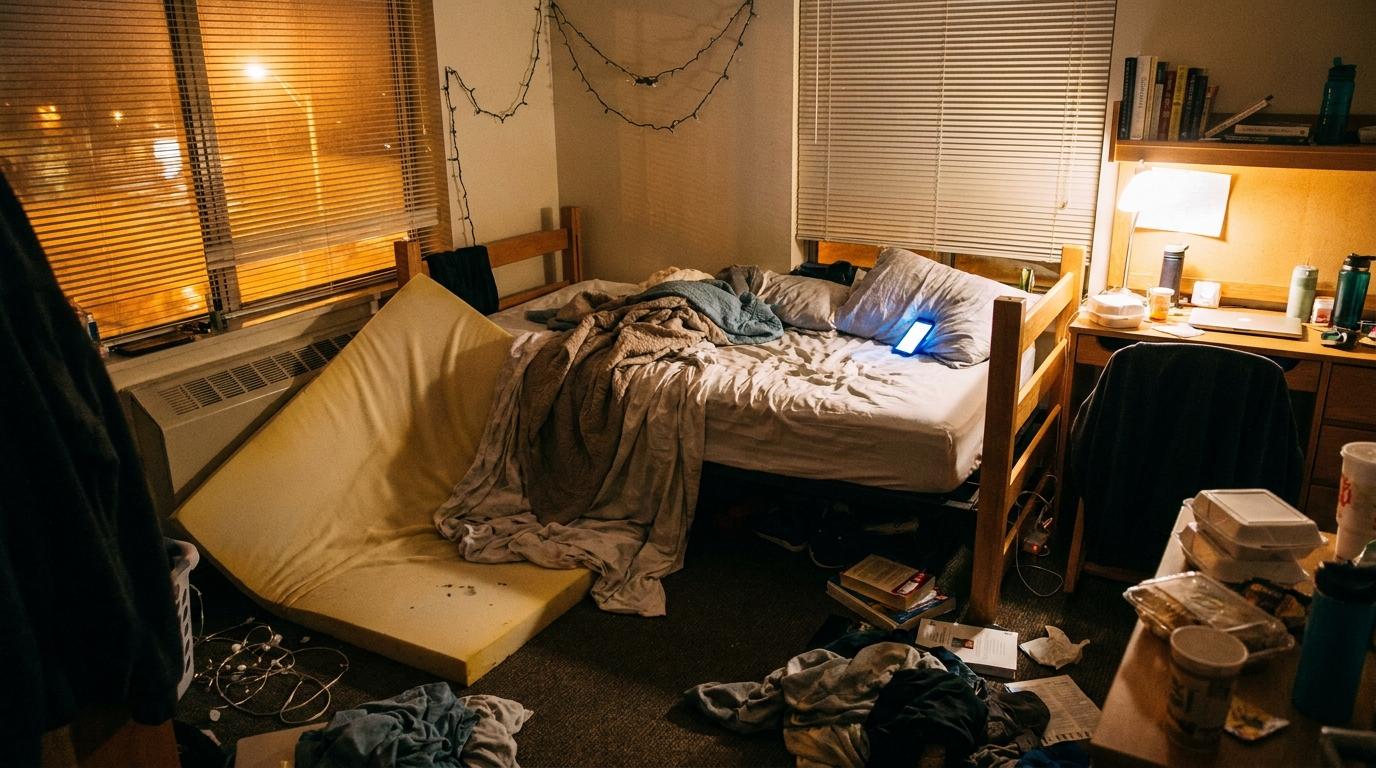
The Dorm Mistakes Nobody Warns You About
Everyone warns you to bring shower shoes and a power strip. Nobody warns you that your sleep situation in a dorm is probably going to be quietly terrible—and that most of it is your own fault.
These aren't major disasters. They're the small, fixable mistakes that add up to weeks of bad sleep, groggy 8 AMs, and falling asleep in the middle of your intro econ lecture. Here are the ten most common ones, and what to do instead.
1. Not Testing Your Bed Before Move-In
Most students throw their fitted sheet on the mattress, call it done, and then spend the first semester wondering why they sleep terribly. Dorm mattresses vary wildly. Yours might be fine, or it might feel like sleeping on a cafeteria tray.
Fix it before it's a problem: bring a mattress topper. Even a basic one makes a significant difference. Just keep in mind that mattress toppers have a sliding problem (more on that in a second).
2. Not Securing Your Mattress Topper
Add a mattress topper to a dorm bed, and you've created a new problem: it slides. You wake up at 2 AM and half your topper is off the mattress. Your fitted sheet is bunched up under you. Nothing is where it was when you fell asleep.
Bedly Straps exist specifically to fix this. They secure your mattress topper and fitted sheet together so your whole bed setup stays put all night. It's a small thing, but it makes a real difference when you're trying to actually stay asleep.
3. Skipping Curtains or a Sleep Mask
Dorm windows have blinds—sometimes. Those blinds block approximately 40% of the streetlight outside. Add in the glow from your roommate's phone, the hallway light under the door, and whatever building has every light on at 3 AM, and your room is not dark.
A basic sleep mask costs less than a pizza and solves this instantly. If you want to go fancier, blackout curtains help too.
4. Choosing Sheets Based on Thread Count Alone
A high thread count doesn't automatically mean better sheets—especially in a dorm that runs warm. Some 600-thread-count cotton sheets are actually less breathable than a well-made bamboo set.
For dorm beds, breathability matters. If you sleep hot or your room doesn't have great AC, look for sheets made from bamboo viscose. The Bedly Bamboo Viscose Twin XL Bed Set is built for this—soft, breathable, and made to fit Twin XL dorm beds so you're not wrestling with sheets that pop off constantly.
5. Keeping Your Phone on the Bed
Not on the nightstand, not charging across the room—on the bed, face up, so every notification lights up your face while you're asleep. This is the most common mistake and the easiest to fix: put it somewhere else before you try to sleep.
Even on Do Not Disturb, a phone in your hand at 2 AM is going to get checked. Put it across the room. You'll thank yourself.
6. Trying to Sleep Through Roommate Noise Without Saying Anything
The martyrdom approach—suffering in silence while your roommate plays video games at midnight—helps no one. Most roommates will agree to headphones and a loose quiet-hours understanding if you just ask.
It doesn't have to be a serious conversation. A quick "hey, could you use headphones after midnight?" is usually enough. If your roommate is actually unreasonable, that's what RAs are for.
7. Napping for Three Hours in the Afternoon
Long afternoon naps feel great in the moment and then completely ruin your ability to fall asleep at night. Then you're up until 2 AM, you sleep through your first class, and the cycle continues indefinitely.
If you need to nap, keep it to 20–30 minutes. Set an alarm. Do not lie down on your bed with no plan—that's a four-hour nap waiting to happen.
8. Ignoring Room Temperature
Dorm thermostats are either broken, shared with a hallway you don't control, or set to "surface of the sun." You can't always control the temperature, but you can control your bedding.
Lighter, breathable bedding adjusts better to temperature swings than heavy cotton sets. This is especially true in fall when the heat kicks on before it's actually cold outside.
9. Treating Every Night Like the Weekend
Staying up until 3 AM on Tuesday because you stayed up until 3 AM on Saturday is how sleep debt accumulates. Your body doesn't care about your social calendar. Inconsistent sleep times make everything harder—including waking up for class and actually absorbing what happens there.
You don't need a strict bedtime. But having a general window you aim for most nights goes a long way toward not feeling permanently exhausted.
10. Thinking You'll Catch Up on Sleep Over the Weekend
Sleep debt doesn't work like a bank account. Sleeping 11 hours on a Sunday doesn't erase five nights of 5-hour sleep. It might help you feel better in the moment, but the effects of sleep deprivation don't fully reverse that quickly.
The actual fix is building a more consistent sleep pattern going forward—not bingeing on sleep once a week and hoping for the best.
FAQ: Freshman Dorm Sleep Mistakes
Do I really need a mattress topper for a dorm bed?
Not everyone does, but many students find dorm mattresses uncomfortable enough that a topper makes a real difference. If you add one, just make sure to secure it—a sliding topper is worse than no topper at all.
What's the easiest upgrade I can make to sleep better in a dorm?
A sleep mask and earplugs cost almost nothing and address the two biggest dorm sleep problems: light and noise. Start there before buying anything else.
How do I talk to my roommate about sleep without it being awkward?
Keep it casual and specific. "Hey, I've been having trouble sleeping—could we agree on headphones after midnight?" is easy for most people to say yes to. Don't make it a confrontation; make it a small, reasonable ask.
Is it bad to have an irregular sleep schedule in college?
It's extremely common—and it does make things harder. An irregular schedule means your body is constantly adjusting, which is tiring in itself. It doesn't have to be perfect, but the more consistent you can be, the better you tend to feel.
Should I bring Twin XL bedding to college?
Yes. Most dorm beds are Twin XL, not regular Twin. Regular Twin sheets will pop off a Twin XL mattress constantly. Check your school's specific bed dimensions, but Twin XL is the standard at most universities.
Dorm Sleep Takeaway
Most freshman sleep mistakes come down to one thing: treating dorm sleep as an afterthought. Your bed setup, your schedule, your roommate agreement, your bedding—all of it matters more than it seems. The good news is that every mistake on this list is fixable, and most of them cost nothing or very little to address. Start with the obvious ones and adjust from there.